You would think the hardest part of my job is matching the perfect candidate to the ideal role.
That is the case sometimes.
But there’s actually another challenge which is often much harder to overcome…
Deciding on the job title.
I know that sounds ridiculous, but believe it or not, it’s true.
Here’s why.
Recently, a client came to me looking for a Senior Treasury Analyst.
But when they explained the responsibilities, it sounded much closer to a Treasury Manager role.
So I asked the obvious question:
“If it’s a Treasury Manager role, why not call it Treasury Manager?”
Their answer was simple.
In their organisation, anyone with a Manager title manages people. This role didn’t. It was an individual contributor position, so they preferred Senior Treasury Analyst.
Fair enough.
But here’s the problem…
Imagine you’re already a Senior Treasury Analyst, and I call you with a new opportunity.
“Great company. More money. Bigger responsibilities. Exciting development plans…
“But you’ll be a Senior Treasury Analyst again.”
The challenge starts immediately.
Because no matter how good the opportunity is, most people compare the title first.
I’ve seen this countless times.
I once recruited for a global multinational where job titles were standardised worldwide.
On paper, that sounds sensible.
In reality, it created confusion.
One role was broadly equivalent to what many companies would describe as an Assistant Treasurer position. Internally, however, the title was Treasury Manager.
One candidate in particular struggled with the decision.
Not because of the work or the compensation…
His concern was how the title would look on LinkedIn.
Eventually, he decided to focus on the role rather than the label attached to it.
We agreed he would join, learn the business, establish himself and then gradually update his profile so it better reflected the reality of what he was doing rather than simply the internal title on his contract.
That proved to be the right decision.
His responsibilities grew, his remit expanded, and his profile evolved to reflect that growth.
Had he focused solely on the title, he would have walked away from a career-defining opportunity.
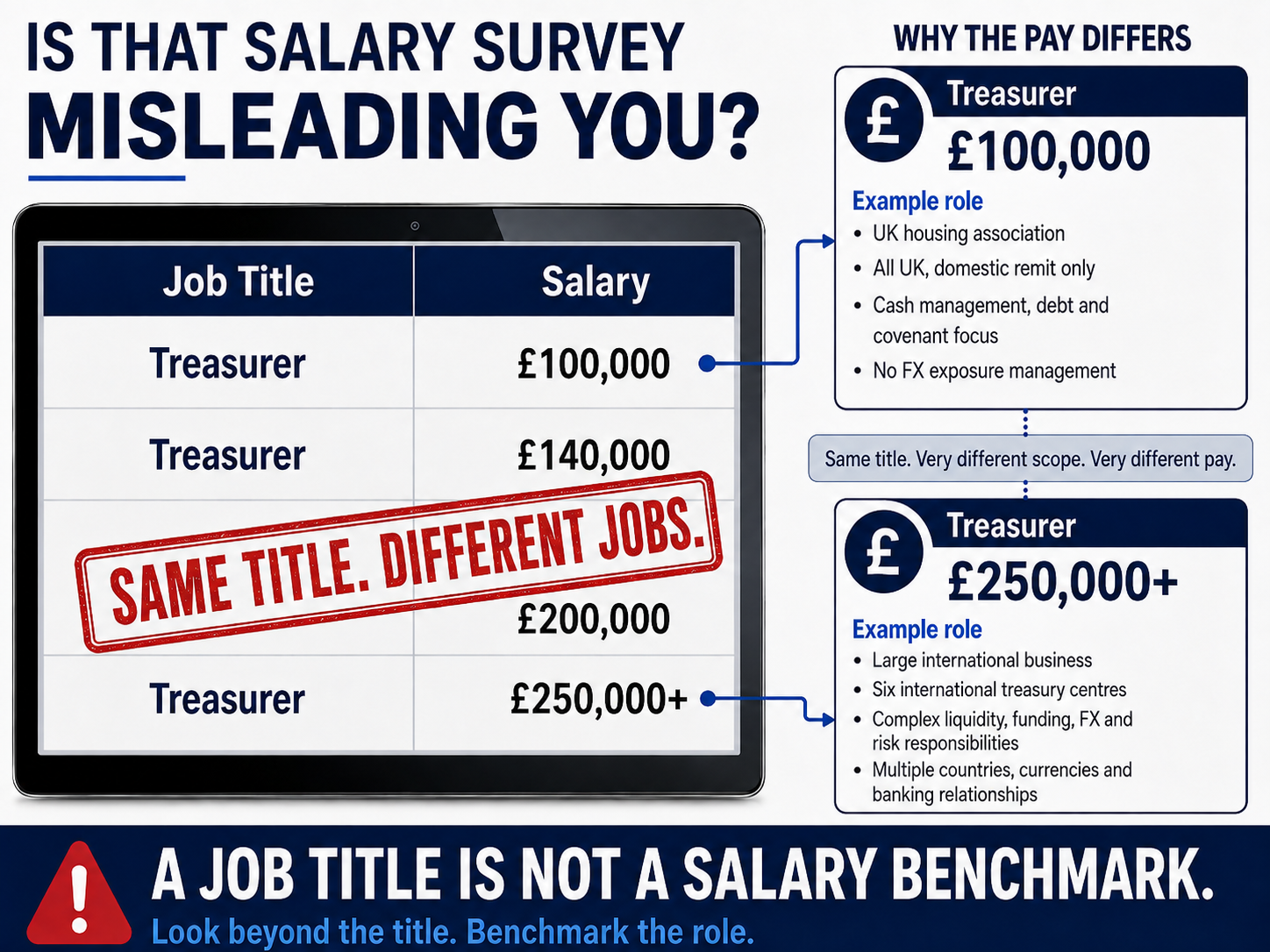
And that’s the danger with job titles.
They influence perception, but they rarely tell the whole story.
Treasury titles don’t mean the same thing everywhere.
Take a Treasury Director.
In the UK, that often means Head of Treasury or second-in-command.
In the US, it can be a mid-level individual contributor with no direct reports.
That’s why, as recruiters, we look beyond titles.
We ask:
- How many people do you manage?
- What are your responsibilities?
- What decisions do you make?
- Where do you sit within the organisation?
That’s how you understand someone’s true level.
So do job titles matter?
Unfortunately, yes.
People are influenced by them.
But a better question than “What’s the title?” is:
“Where could this role take me next?”
Because sometimes the best career move doesn’t come with the most impressive title.
It comes with the biggest opportunity.
And those two things aren’t always the same.
Best regards,
Mike