We’re coming up to that time of year again. April approaches, companies start doing their annual reviews, and treasury professionals begin thinking about pay.
And I see the same mistakes happen again and again…
Here’s the first one:
Someone walks into their manager’s office and says, “I want a pay rise.”
Starting with that question is the fastest way to end the conversation.
Your salary is there to pay you for doing your job.
You are paid a salary for turning up each day.
Managing the cash, running the liquidity, handling the FX exposure, dealing with the banks, and delivering the reporting, etc.
That’s the basic duties of your role.
If the conversation starts with “I want a pay rise”, the natural response from a manager is simple:
“Why?”
And they would be completely within their rights to follow up with:
“What have you done to deserve one?”
That’s where lots of people I chat to get stuck.
If you can’t say where you’ve gone above and beyond your job and MADE A DIFFERENCE, then honestly, you shouldn’t be getting a pay rise.
Before you even ask the question to your manager, answer these questions:
- Have you saved the company money?
- Have you delivered a major project?
- Have you implemented a new treasury system?
- Have you reduced costs or streamlined processes?
If you’ve done something that materially improved the business, that should be your starting point.
For example, if you implemented a treasury management system that reduced manual work and effectively replaced three or four full-time roles, that’s real value.
You’ve saved the company money.
Start with that. Now the pay discussion becomes logical rather than emotional.
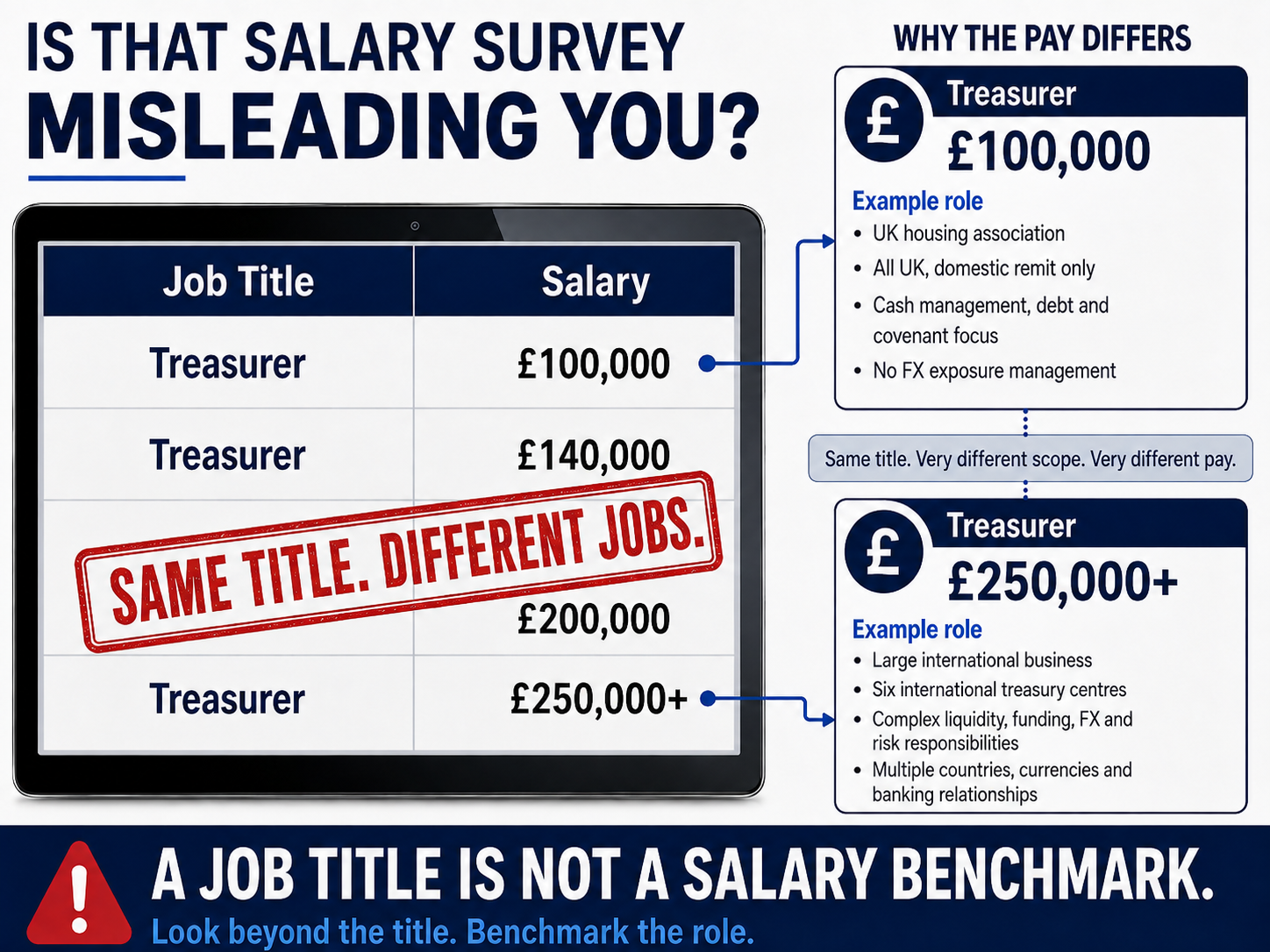
Another mistake people make is leading with market data, like our salary survey.
Yes, that data is there to help you. But that doesn’t mean you should walk in and say:
“Mike’s salary survey says I should be paid £80,000.”
Again, that’s the wrong order. The sequence should be:
- Give evidence for the value you’ve delivered
- Explain how your role has grown
- Then benchmark the salary
The salary survey is the final piece of the puzzle.
It should support your case, not be the entire basis of it.
So, with all this considered, the reality is that not everyone will deserve a pay rise this April.
But every once in a while, I come across someone who is genuinely underpaid…
I’ll look at their CV and be impressed, ask what they earn, and almost fall off my chair knowing that I could get them a 30% pay rise tomorrow.
Why does that happen?
Often, because they’ve never benchmarked themselves. They’ve stayed in the same role for years, doing great work, but never tested their market value.
And you don’t have to leave your job to understand your value.
You can look at a salary survey to benchmark it.
You can talk to peers at conferences.
Compare responsibilities.
Sometimes two people are doing almost identical roles, and one of them is earning £10k to £20k more. The only difference between them is that one of them asked around.
To close, I just want to say that there’s a final point worth remembering:
Salary isn’t the whole story.
When we analyse the data from our treasury salary survey, pay is seldom why people leave a job.
It’s a factor, yes. But it’s not the biggest one.
What you tend to see is:
- Lack of progression
- Frustration in the role
- Poor leadership
- Limited development opportunities
Salary sits somewhere in the mix, but it’s never the whole story.
So, if your pay review is coming up, here’s a simple rule:
Don’t walk into the room asking for a pay rise. Go in prepared to explain the value you’ve created.
If you can clearly show how you’ve improved the business, saved money, or delivered meaningful change, the pay conversation becomes much easier.
And if you’re not sure where your salary sits in the market, that’s exactly why we produce the Treasury Salary Survey twice a year.
It’s there to give you the data to support the conversation. But ONLY once you’ve made the case.
Best regards,
Mike
P.S. Have you benchmarked your salary yet? Click here to see where you stand.