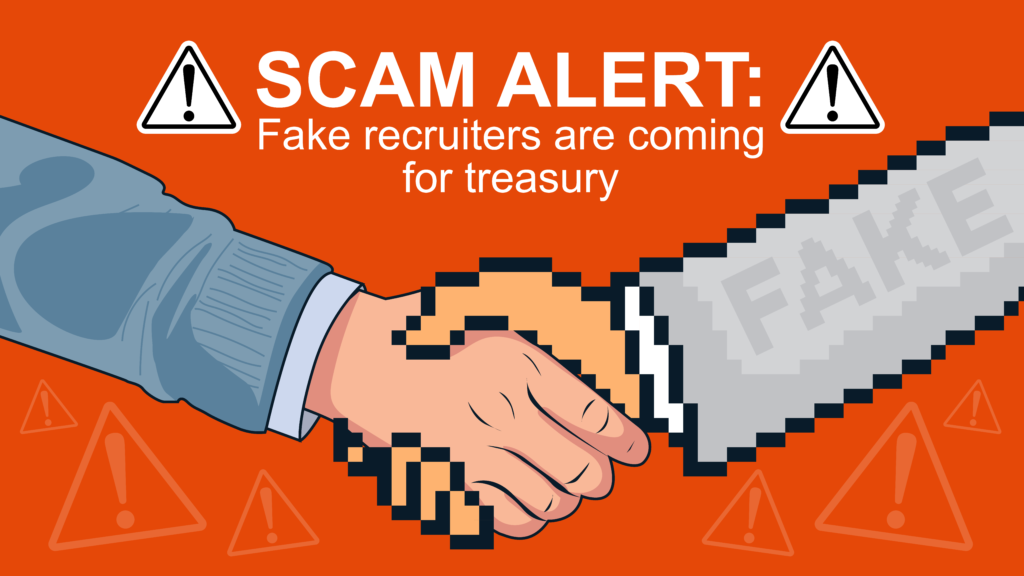
I’ve had more and more treasury professionals reaching out to me recently, saying:
“Mike, does this look legitimate?”
Or:
“Do you know this recruiter?”
That in itself tells you something.
Treasury people are generally pretty commercially aware. They’re not usually the easiest people to scam.
But the volume of this stuff is increasing, and some of it is getting much more convincing thanks to AI.
Years ago, you could spot a scam email miles away. They’d all have the trademark broken English and weird formatting. But these days, AI can generate perfectly written outreach in seconds.
So the old warning signs are disappearing.
That’s why treasury professionals need to look beyond the wording itself.
One treasury candidate sent me an approach recently for what was supposedly a confidential Pepsi role.
It looked polished, credible, and well-written.
But then they asked to submit his CV immediately before even speaking to him properly.
That’s your first red flag right there.
A proper recruiter will want to understand you first:
- Your background
- What you’ve actually done
- What you want next
- Whether the role even makes sense
They should NEVER just fire your CV into the market and hope for the best.
A few years ago, this was mainly candidates being targeted. Now it’s treasury professionals, recruiters, and anyone with a visible LinkedIn profile.
So, if you’re active or visible in the market, you’re a target.
I even covered this in a recent podcast with Ben Loper. One thing he’s done is remove his real photo from LinkedIn and replace it with a cartoon image so it can’t be scraped and reused. It sounds drastic, but it shows how far this has moved.
Ben made some really important points throughout the podcast. He explained that the old ways of verifying people online simply don’t work anymore.
In the past, if someone contacted you, you could:
- Google them
- Check their LinkedIn
- Look at their company website
- Watch a video of them speaking
…and assume they were genuine.
Now, AI can create fake websites, cloned voices, realistic avatars, and even fake video calls that look completely legitimate.
That’s why Ben said treasury teams are bringing back some “old-school” fraud checks again:
- Code words
- Known contacts
- Secondary approvals
- Manual verification calls
Because sometimes the simplest checks are now the safest ones.
He even replaced his real LinkedIn photo with a cartoon avatar to stop fraudsters scraping and reusing his image online
“I used to say, okay, this person called me. I can do a Google search. I can go to their website. I see their picture, I see ’em on video. Okay. This is really that person. Now with AI avatars and the ability to create synthetic voices, you can’t do that anymore.”
“It doesn’t take a lot of resources to completely fabricate a vendor or anything like that.”
In the show he also explained that they had changed their photos on certain platforms because;
“Cartoon avatars are nice because obviously if a cartoon calls you that something’s up…”
Now, to give you one real example, I was recently approached by a firm called “Global Executive Careers.”
They offered to introduce a candidate to me for free – how generous, right?!
…it wasn’t.
They were charging the candidate and then pushing their CV out to recruiters under the guise of “introductions.”
So, now how do you spot these fake “recruiters” when, at first glance, they appear perfectly normal…
If you work in treasury recruitment every day, it’s easy to spot. If you don’t, it’s very easy to miss.
You just have to do a little digging.
If you’re ever in doubt, here are the questions you should be asking:
- Does the recruiter actually have a track record?
- Do they have recommendations?
- Have they placed treasury people before?
- Do they understand treasury properly?
- Can you find evidence they’ve been around for years rather than weeks?
Or does it all feel a bit… thin?
One really useful trick is to reverse search an image.
I had a fake “treasury recruiter” years ago using what turned out to be a stock image.
One quick reverse image search later, and the same woman was apparently a furniture model, a travel blogger, and an executive recruiter… that’s quite the career portfolio!
Here’s how to do a reverse image search:
- Right-click the image
- Save it
- Google a reverse image search engine and upload it
You’d be amazed at what comes back.
You have to be especially careful these days, and I fear it’s only going to get harder to tell the real from the fake.
But if you’re ever in doubt when you’re approached about a treasury role, just slow things down. Ask yourself if this recruiter REALLY understands you. Make sure you’ve spoken to them properly and see if their online presence actually stacks up.
Most treasury professionals are technically very strong. But this isn’t about technical treasury knowledge. It’s about awareness.
The scams ARE getting better. The emails are cleaner. The profiles look more convincing.
And that’s exactly why people are starting to get caught out.
But once you know what to look for, you’ll be back to spotting them from a mile away.
Best regards,
Mike
P.S. If you’re feeling doubtful about a recruiter’s credibility, let me know and I’d be happy to take a quick look into them for you.